
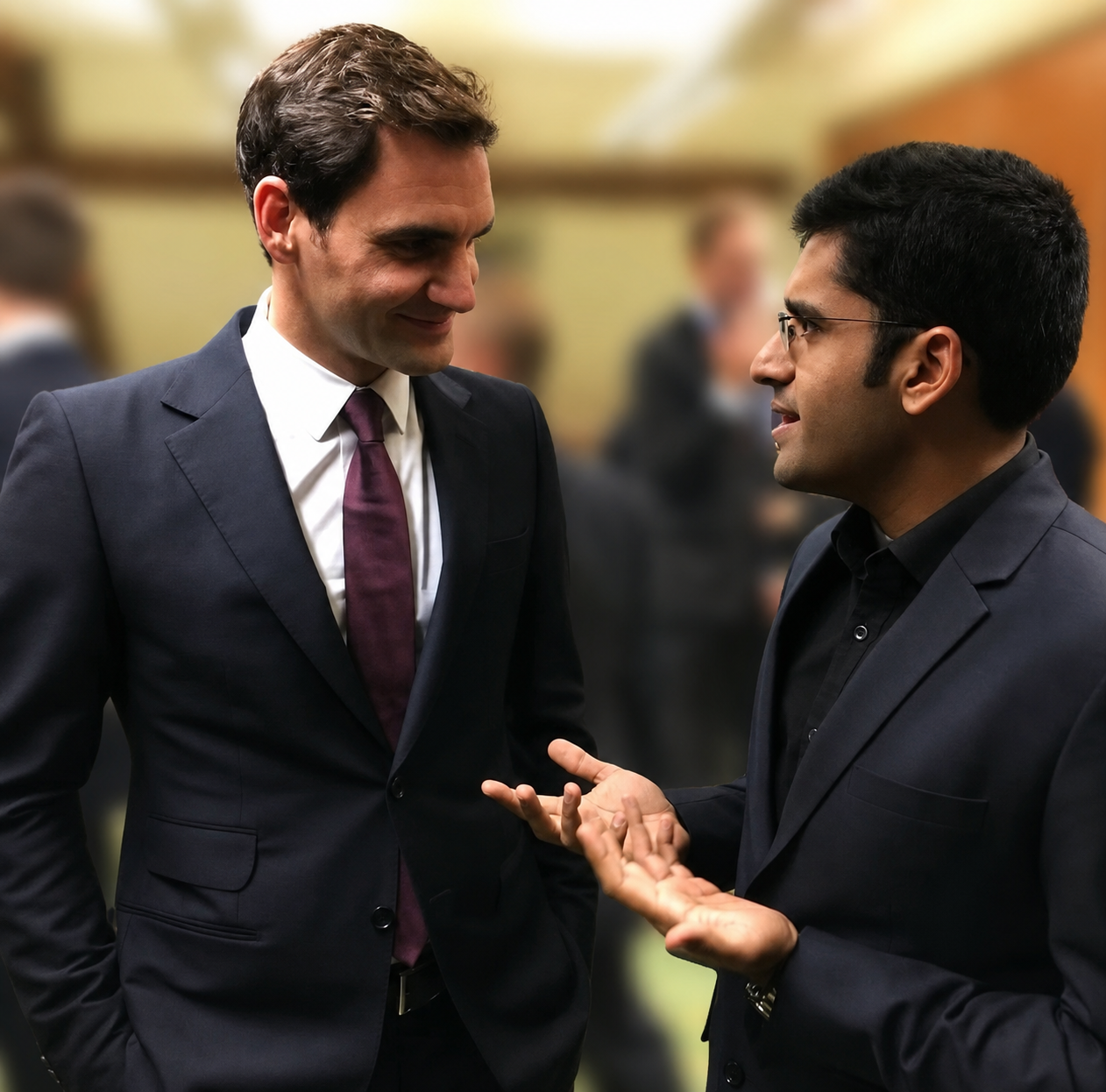
In a room full of strangers, he stood right at the centre of it – the way he always does, effortlessly, naturally. Everyone around him was spellbound. I was too. But I had a question I’d been rehearsing all week, and this might be my only shot.
Mustering every bit of courage I had, I walked up and said: “Hello, good evening Roger. My name is Dhruv. I’m from Infosys. Would it be alright if I asked you something?”
He turned, smiled – the kind of smile that makes you feel like an old friend – and said, “Yes, of course Dhruv. Fire away.” I was surprised he got my pronounciation right.
So I did.
“In 2015, you won over 80% of your first serve points on the ad court – significantly higher than in previous years. You also held serve from 40-0 up on 387 occasions that season. In my observation, what do you think drove those numbers?”
He paused. Looked at me – a 5’9″ Indian guy armed with tennis statistics – and I watched something shift in his expression. Not dismissal. Curiosity.
“Wow,” he said. “Those are tremendous numbers, really. I don’t look into data that often, honestly. But… hmm, let me think. I’ve realised I need to reinvent my game and need to end points quicker. So maybe I’ve been charging the net to volley a lot more often. That’s probably it. And I’m quite decent at the net.”
He said it with a grin. Modest, precise, warm.
I had spent an entire week preparing that one question on the off chance this moment would come. And in the thirty seconds that followed, Roger Federer made a nervous guy from Pune feel completely at ease – locking into a genuine conversation about tactics, stats, and the quiet intelligence behind his game.
That’s the thing about him that statistics will never fully capture. The numbers tell you he was the greatest. But the man himself makes you feel like the most interesting person in the room.
Roger Federer announced his retirement in 2022. The sport lost its most elegant champion. But what he leaves behind goes far beyond titles and trophies – a foundation that has educated over 1.8 million children across Africa, a standard of grace under pressure that an entire generation of players has tried to emulate, and the memory, for those lucky enough to have been in the same room, of just how rare it is when greatness is also genuinely kind.
Rafa. Novak. Serena. All legends in their own right.
But Roger? Roger is something else entirely. And that evening, for a few minutes, he did what only the truly great ones do – he stepped across every barrier of fame and status and stood right there with me. No hierarchy. No distance. Just two people talking about tennis data.
Loved reading it. Share more of those heart to heart conversations you had in all these years with the greatest of tennis. Surely it can fill a book of memoirs.
Lovely! Shall look forward to your next story